




Executive Summary
Essential Aero is transforming airport ground operations through autonomous robotics, tackling one of aviation’s most persistent safety challenges: foreign object debris (FOD). According to the FAA’s research, FOD is responsible for an estimated $22 billion in damage globally each year, posing a serious and ongoing risk to aircraft, personnel, and mission readiness. To enable the centimeter-level precision that safe, autonomous FOD collection demands, Essential Aero partnered with Swift Navigation, deploying the Skylark™ Nx RTK corrections service. Skylark delivers consistent sub-8 cm accuracy across airfield operations to keep Essential Aero’s robots geofenced strictly within their designated areas of operation, a capability that is safety-critical in the highly regulated, high-stakes environment of an active airport.
The Challenge: FOD – A $22 Billion Global Cost Sink
Foreign object debris is among the most serious and costly hazards in aviation. Any item on or near a runway or taxiway, from a bolt to a piece of tire rubber, can cause catastrophic damage to engines, landing gear, and fuselage. The financial toll of FOD-related damage, downtime, and remediation runs into the tens of billions annually, affecting military, federal, and civilian airports alike. The 2000 crash of Air France Concorde Flight 4590 – in which debris on the runway ignited a tire explosion that brought down the aircraft, killing all 109 people on board – remains the most devastating reminder of what a single piece of FOD can do.
Current FOD management methods are largely manual: at many airports in the United States, personnel hitch collectors to vehicles and sweep runways and taxiways by hand. In Europe, the picture is often even more rudimentary. At numerous airports, FOD patrols are conducted by staff on bicycles, manually scanning the runway surface, a process that can take hours to complete. These approaches offer limited coverage, inconsistent tracking, and depend heavily on human vigilance – a significant liability in environments where a single missed fragment can ground aircraft or worse. As one Essential Aero engineer described it, manual FOD sweeps are like “mowing your lawn when you can’t see the line behind you.”
For autonomous robots to replace these manual workflows, they must navigate with extraordinary precision, and they must stay exactly where they’re supposed to be. Essential Aero’s robots are programmed to halt immediately if their positional error exceeds 8 centimeters. On an active airfield, operating even slightly outside a designated zone can cause a major safety incident.
Standard GPS cannot meet this requirement. Meter-level accuracy is far too imprecise for safe ground operations, and airports compound the challenge with dense electronics infrastructure: radar arrays, communication systems, and potential jamming – all of which degrades GNSS signal quality. The open, featureless geometry of runways also limits the effectiveness of LiDAR-only navigation. Essential Aero needed a positioning solution that was precise, robust against interference, and capable of enforcing strict geofenced operating boundaries.
The Solution: Geofenced Precision with Skylark Nx RTK
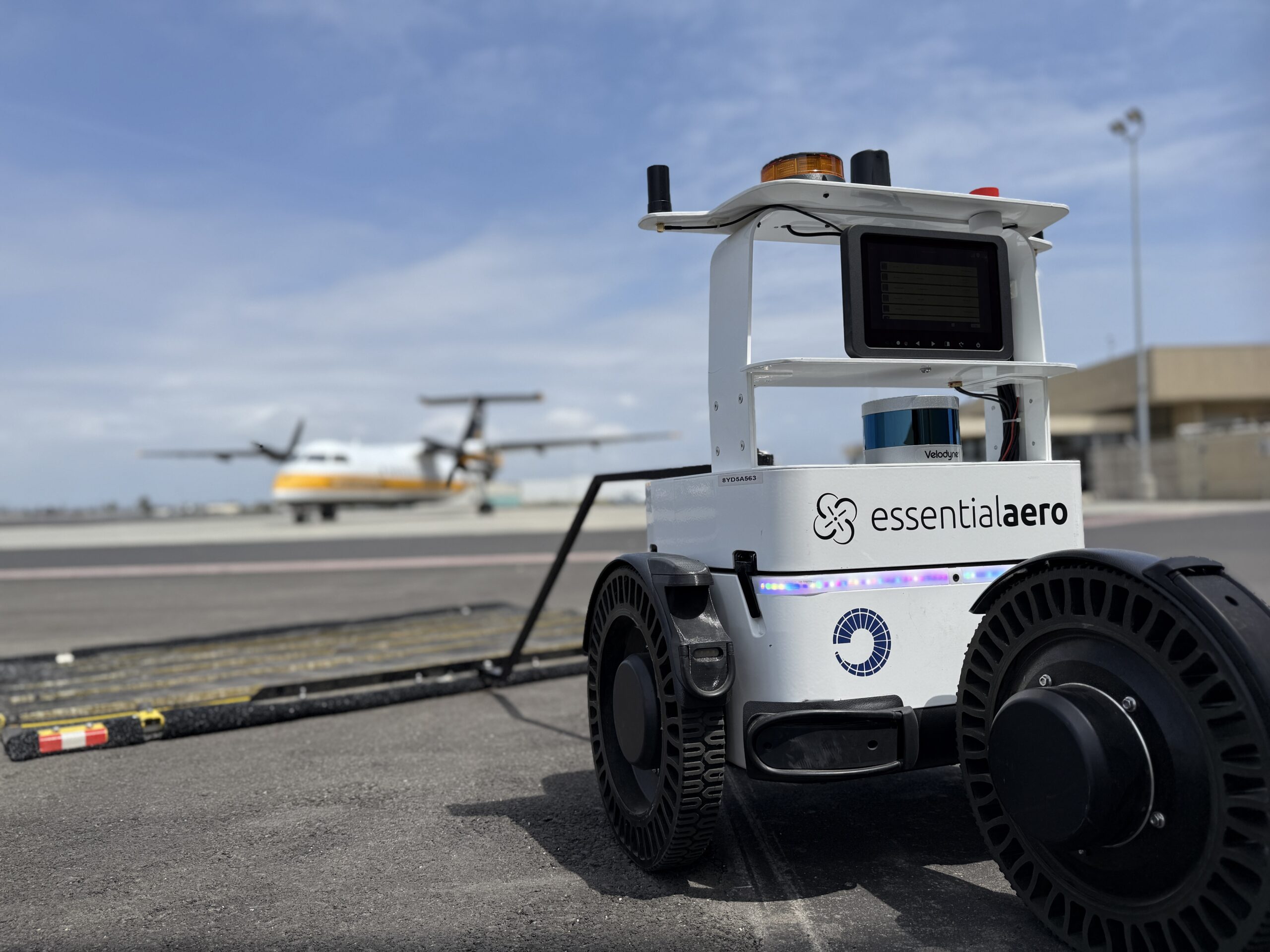
Essential Aero’s autonomous ground robots use a hybrid navigation architecture that combines LiDAR for indoor and feature-rich environments with Skylark Nx RTK for outdoor airfield operations. Skylark, Swift Navigation’s cloud-based GNSS corrections service, delivers 1–2 cm accuracy through a Virtual Reference Station (VRS) network with advanced atmospheric modeling. This gives Essential Aero the positioning integrity their safety-critical robots demand.
Critically, Skylark enables Essential Aero to enforce precise geofences around each robot’s designated operating zone. On an airport surface, this is a fundamental safety requirement. Knowing with centimeter-level confidence exactly where a robot is, and constraining it to pre-approved areas, is what makes autonomous airfield operations viable from both a safety and regulatory standpoint.
Essential Aero initially explored building their own RTK network using physical base stations, but found the approach costly, complex, and limited in geographic reach. Skylark’s cloud-delivered corrections model eliminated that infrastructure burden entirely, providing nationwide coverage with plug-and-play deployment and no local hardware to maintain. The service also demonstrated strong resilience against the signal interference and potential jamming common at busy airports.
Why FOD Automation Matters
The enormous cost associated with FOD encompasses engine ingestion events, tire damage from runway debris, maintenance delays, grounded aircraft, and in the most serious cases, accidents with loss of life. For military customers like the U.S. Air Force, FOD on a flight line can ground entire fleets and compromise operational readiness. For civilian airports, even minor FOD incidents translate to expensive repairs, insurance claims, and potential regulatory consequences.
Automating FOD collection with precise, geofenced robots addresses the problem in a fundamentally different way than manual methods. Coverage is comprehensive and systematic rather than dependent on individual attention. Every sweep is tracked. The robot does not get tired, distracted, or skip a section. And with Skylark maintaining centimeter-level positioning, the robot always knows exactly where it has been and where the boundaries of safe operation lie.
The Result: Safe, Scalable Airfield Automation
With Skylark Nx RTK at the core of their navigation stack, Essential Aero’s robots stay within their predefined safety threshold of sub-8 cm positional accuracy and geofenced areas are reliably enforced. The cloud-based architecture has eliminated the cost and complexity of physical base station infrastructure, enabling Essential Aero to deploy rapidly at new sites without bespoke setup.
Essential Aero’s customers have benefited from faster, more cost-efficient operations. Airport personnel report improved morale as time consuming and repetitive tasks are handed off to the autonomous platform.
Looking Ahead: Scaling to Civil Aviation
Following successful deployments with the U.S. Air Force and FAA, Essential Aero is now expanding into civilian aviation. The company is currently raising a seed round to support production of FOD collection robots for commercial airfields, with pilots underway at four airports in the Western United States — each operating multiple robots. The goal is to demonstrate the ROI of autonomous FOD management at scale and establish the technology as a core component of modern airport infrastructure.
"Operating autonomous robots on an active airfield is one of the most demanding positioning challenges imaginable. The safety bar is absolute. A robot that drifts outside its designated zone isn't merely inefficient, it poses a significant safety threat. Skylark is one of the tools that makes it possible for us to operate with that level of confidence. It gives us centimeter-level accuracy, it keeps our robots geofenced within their approved areas, and it does so consistently – without the overhead of building and maintaining our own ground infrastructure"
Steve Boyle — CEO, Essential Aero
Conclusion
Through its partnership with Swift Navigation, Essential Aero has built a credible, safety-validated approach to one of aviation’s most persistent hazards. Skylark Nx RTK provides the centimeter-level precision and geofenced operational control that autonomous airfield robots require — making it a foundational technology for any deployment where safety, regulatory compliance, and positional integrity are non-negotiable.
Learn more: Essential Aero | Skylark for Robotics | Skylark Nx RTK