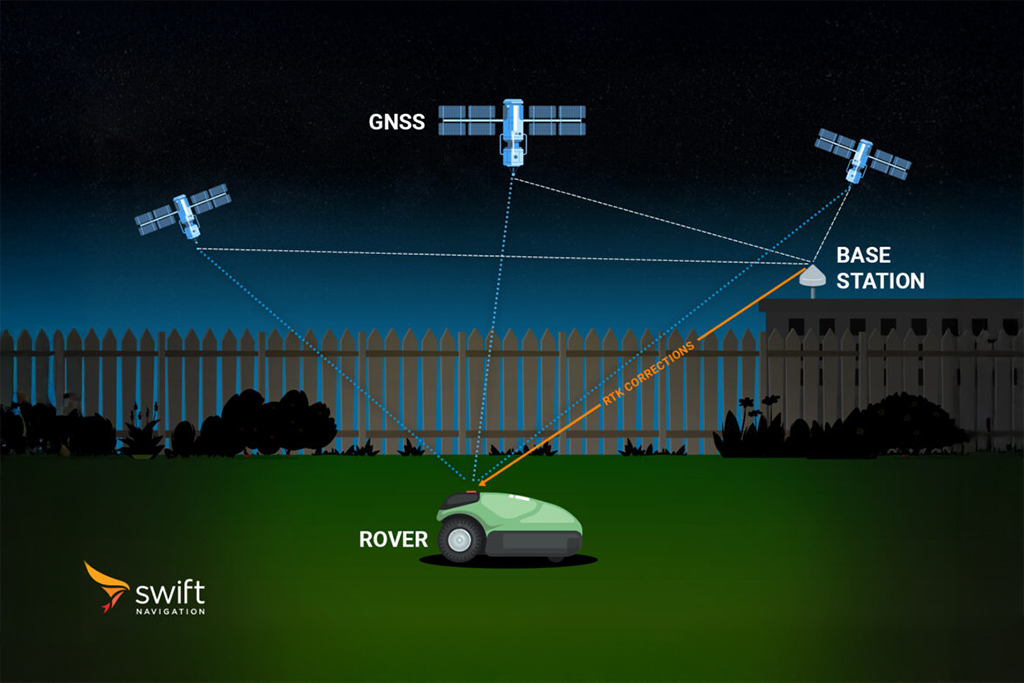
Network RTK (Real-Time Kinematic) is a GNSS correction technique that delivers centimeter-level positioning accuracy over broad geographic regions. Unlike traditional single-base RTK—which relies on one local reference station and experiences accuracy loss with increasing distance—Network RTK integrates data from multiple continuously operating reference stations (CORS) spread throughout a region. By leveraging this network, spatially correlated errors (such as those caused by atmospheric delays, satellite orbits, and clock errors) are modeled collectively, and corrections are interpolated precisely based on the user’s real-time location.
How Network RTK Works
A Network RTK system operates in four steps:
Reference network data collection: Multiple CORS stations distributed across a region simultaneously collect GNSS data and transmit raw observations to a central processing server.
Error Modeling: The network analyzes errors like ionospheric and tropospheric delays that affect positioning, generating correction data tailored to each rover’s position.
Data Delivery: Corrections are typically provided over internet protocols such as NTRIP (Networked Transport of RTCM via Internet Protocol) in standardized formats like RTCM 3.x, which ensures compatibility with most modern RTK receivers.
Virtual Reference Stations (VRS): In some implementations, the system synthesizes a “virtual” base station near the rover’s position, sending corrections as if a physical station were nearby — dramatically shortening the effective baseline and maximising accuracy.
Network RTK vs. Single-Base RTK
Base station required: Single-base requires the user to own and operate a physical station. Network RTK is subscription-based — the provider manages all infrastructure.
Coverage: Single-base covers ~20–30 km radius. Network RTK can facilitate a much broader coverage footprint.
Accuracy vs. distance: Single-base accuracy degrades severely with distance. Network RTK maintains a much tighter bound for degradation, often providing 1–2 cm across the coverage area.
Redundancy: Single-base has no redundancy if the station fails. Network RTK automatically routes around problem stations.
Setup cost: Single-base requires hardware purchase, installation, and maintenance; Network RTK is subscription-based.
Common Applications of Network RTK
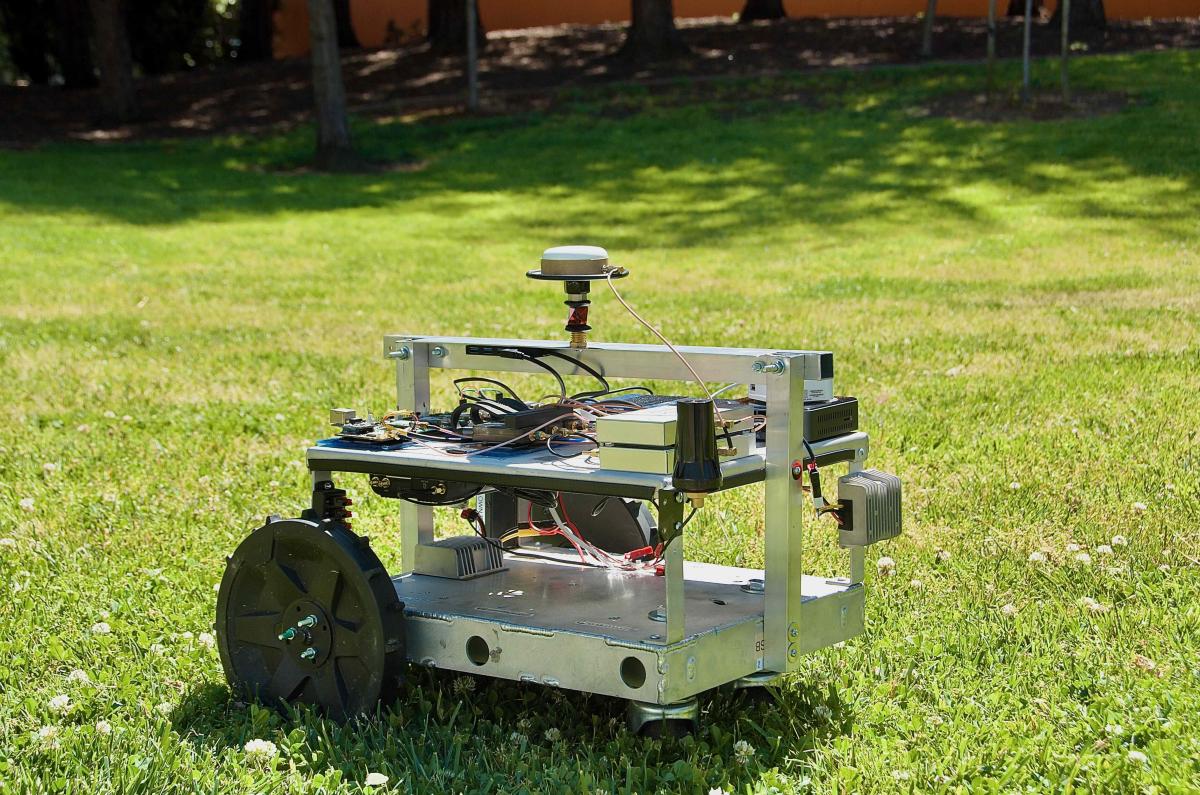
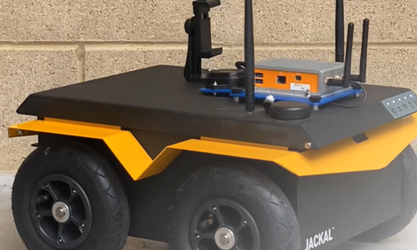
Robotics & Autonomous Machines — outdoor robots operating over large areas where a reliable service is crucial to prevent accidents.
Surveying & GIS Mapping — field professionals across a region can access the same network without needing to be trained how to set up a base station.
Drone Operations — drone fleet operators across wide coverage areas benefit from a single, consistent correction source.
Construction — plug-and-play RTK accuracy without having a surveyor set up a base station.
Swift’s Skylark Nx RTK exemplifies Network RTK’s capabilities—providing rapid convergence, broad coverage, and support for multiple global reference frames (e.g., ITRF2020, NAD83), making it suitable for a wide range of high-precision, large-scale operations.
No. With a Network RTK service, the provider operates all reference station infrastructure. You only need a compatible GNSS rover with an internet connection to stream corrections via NTRIP.
Both enable wide-area precise positioning without a local base station. Network RTK uses regional station networks to deliver very fast (instant to seconds) fix times with 1–2 cm accuracy. Standard PPP relies on global satellite corrections and can take 20–40 minutes to converge. PPP-RTK combines both approaches for fast convergence with global-scale infrastructure.
Network RTK is inherently redundant. The server detects station failures and redistributes correction modelling across remaining stations. Users typically see no service interruption.
Any GNSS receiver supporting RTCM 3.x input and NTRIP connectivity is compatible with Network RTK. To see if your device it compatible, use our Compatibility Checker Tool.